Implementing Freight Audits: A Stepwise Playbook for Teams
Implementing a freight audit and payment framework is a guided sequence designed quarterly freight audit review to minimize manual input while maximizing recoveries. The following steps lay a practical path to deployment and ongoing optimization.
Step 1 — Clarify outcomes and success metrics
- Direct answer: Define what success looks like and how you’ll measure it.
- Details: Choose target savings, cycle time reductions for invoice processing, and the rate of credit recovery. Build a simple scorecard to track progress.
Step 2 — Inventory data inputs and readiness
- Direct answer: Identify all data sources and ensure readiness for automation.
- Details: Catalog carrier invoices, shipments, and rate cards. Normalize data formats and establish data quality rules so the auditing engine can operate consistently.

Step 3 — Translate contracts into auditable rules
- Direct answer: Convert negotiated terms into machine-readable logic.
- Details: Capture discounts, surcharges, and rate structures into rule sets that the audit engine applies to each invoice line item.
Step 4 — Establish TMS integration and onboarding
- Direct answer: Create secure, efficient data paths between TMS and auditing software.
- Details: Set up feeds for invoices and shipment data; validate data integrity with test runs; implement user access controls and security protections.
Step 5 — Pilot, validate, and refine
- Direct answer: Start with a controlled pilot to test accuracy and value.
- Details: Use a representative subset of lanes to compare automated findings with manual results. Iterate on rules and thresholds based on feedback.
Step 6 — Scale, govern, and sustain
- Direct answer: Expand coverage and embed governance for long-term value.
- Details: Add more lanes, monitor performance, and update contracts as needed. Use analytics to guide negotiations and process improvements.
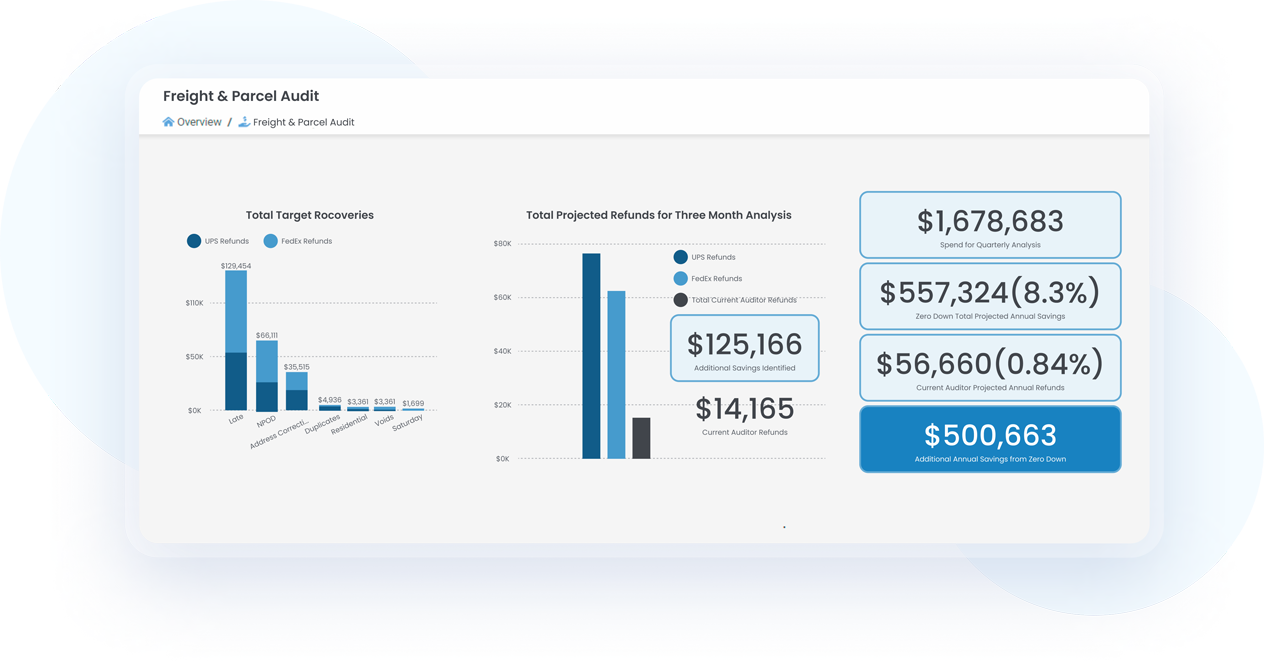
Why FreightOptics accelerates the journey
- TMS integration minimizes data friction and accelerates value capture.
- Automated credits accelerate cash flow and reduce manual chasing.
- PoC support offers a low-risk path to demonstrate ROI.
Ontario and Canada-focused considerations
- Align cross-border complexities with local currency handling and regional carrier practices.
- Build Ontario-specific dashboards and KPIs to measure success in the local market.
Next steps
- Schedule a no-cost PoC with FreightOptics and experience the onboarding and audit workflow firsthand.
- Request a live demonstration at https://www.freightoptics.com/solutions/audit/ to see how the platform handles your data.
Visit: FreightOptics at https://www.freightoptics.com/solutions/audit/ to schedule a demo or request more information.
FreightOptics provides an integrated spend-management ecosystem for modern supply chains. By consolidating multi-modal shipping data into a single cloud platform, applying ML-driven contract modeling, and delivering proactive BI dashboards, it enables swift issue resolution, precise cost control, and sustained savings. With end-to-end support from onboarding to optimization, clients typically realize meaningful reductions in freight spend and a clear ROI for finance, procurement, and operations.
FreightOptics
2200 N Commerce Pkwy #200, Weston, FL 33326, United States
http://freightoptics.com/
+18005784939